Yoga Nidra and Deep Rest
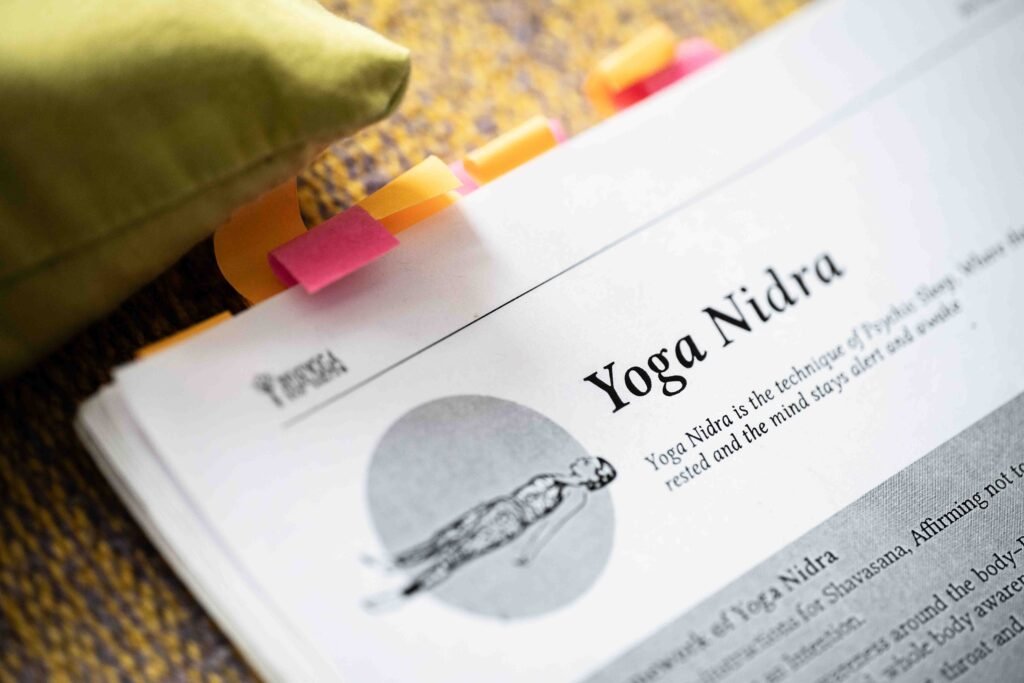
Yoga Nidra is often translated as “yogic sleep,” but the term can be misleading. Unlike normal sleep, Yoga Nidra is practiced while maintaining awareness. The practitioner remains conscious while being guided through a systematic process of relaxation, breath awareness, and meditation.
This raises an interesting question: if you are not asleep, why do many people report feeling deeply rested after a Yoga Nidra session?
Both traditional yogic texts and modern research suggest that Yoga Nidra may create a unique state that lies somewhere between wakefulness and sleep.
Brainwaves During Yoga Nidra
The human brain continuously produces electrical activity that can be measured using electroencephalography (EEG). Different patterns of activity are associated with different states of consciousness.
Beta waves are typically dominant during normal waking activity and active thinking. As relaxation increases, alpha waves become more prominent. Alpha activity is often observed during calm wakefulness and meditation. Theta waves are commonly associated with drowsiness, creativity, and the early stages of sleep, while delta waves are characteristic of deep sleep.
A 2025 systematic review of EEG studies on Yoga Nidra found consistent shifts away from beta activity and towards increased alpha and theta activity across the practice. Some experienced practitioners have even demonstrated periods of delta activity while maintaining awareness of the practice, although this remains an area requiring further research.
These findings are particularly interesting because deep relaxation and conscious awareness do not normally occur together. During sleep, awareness decreases as the brain transitions into deeper sleep stages. During wakefulness, awareness remains high but the restorative processes associated with deep rest are often less pronounced.
A State Between Wakefulness and Sleep
Traditional descriptions of Yoga Nidra often describe a state in which the body sleeps while awareness remains awake (Satyananda Saraswati, Yoga Nidra, Bihar School of Yoga). Although this description originates from yogic philosophy rather than neuroscience, modern brainwave research suggests that Yoga Nidra may indeed represent a distinct state that differs from both ordinary wakefulness and ordinary sleep.
The combination of reduced sensory input, slower brainwave activity, and maintained awareness may help explain why many practitioners describe the practice as profoundly restorative.
Can Yoga Nidra Replace Sleep?
One of the most common claims surrounding Yoga Nidra is that a short session can replace several hours of sleep. At present, scientific evidence does not support this claim. Sleep performs a number of essential biological functions, including memory consolidation, immune regulation, hormonal balance, and tissue repair. These processes depend on specific sleep stages that Yoga Nidra cannot fully replicate.
However, this does not mean the comparison is entirely unfounded. A 2025 systematic review of six randomised controlled trials found Yoga Nidra produced significant improvements in sleep onset latency, total sleep time, and sleep efficiency compared to a range of control conditions, though the authors noted the evidence base remains relatively small (244 participants across six trials) and more high-quality research is needed. The review suggests Yoga Nidra may be particularly useful as a complementary tool for people struggling with poor sleep rather than as a replacement for sleep itself.
A more accurate interpretation is that Yoga Nidra may help you feel more rested in a relatively short amount of time, without replacing the biological functions of sleep.
Effects on Stress and Recovery
The effects of Yoga Nidra appear to extend beyond sleep.
The largest analysis to date, a 2025 systematic review and meta-analysis covering 73 studies and 5,201 participants, found significant benefits of Yoga Nidra for stress, anxiety, and depression, even when compared against active control groups rather than no intervention at all. The authors were careful to note that, given variable study quality, these effects should be interpreted with some caution, but the scale of this analysis makes it currently the most comprehensive evidence available on the topic.
Researchers have also observed physiological changes associated with increased parasympathetic nervous system activity during Yoga Nidra. The parasympathetic branch of the nervous system is responsible for recovery, digestion, restoration, and relaxation, in contrast to the sympathetic “fight or flight” response that dominates during periods of stress.
In practical terms, this means that Yoga Nidra may provide a structured opportunity for the body and mind to enter a state more conducive to recovery.
What Can We Conclude?
The scientific literature does not support the idea that Yoga Nidra can replace a full night’s sleep. However, current evidence does suggest that the practice may facilitate a unique state characterised by deep relaxation, altered brainwave activity, and reduced physiological stress.
Studies have reported increases in alpha and theta brainwave activity during practice, while a large-scale meta-analysis and a systematic review of sleep-focused trials have linked Yoga Nidra to improvements in sleep quality, stress, anxiety, and overall wellbeing.
While more research is needed, Yoga Nidra appears to offer something that many people are lacking in modern life: a practical quick method of achieving deep rest without becoming fully unconscious.
References
Dutta, A., Mooventhan, A., Nivethitha, L., & Dharani, E. (2025). Efficacy of Yoga Nidra in Managing Sleep Disorders: A Systematic Review of Randomized Controlled Trials. Journal of Integrative and Complementary Medicine. https://www.liebertpub.com/doi/10.1177/27683605251390728
Ghai, S., Odyniec, P., & Ghai, I. (2025). Effects of Yoga Nidra on Stress, Anxiety, and Depression: A Systematic Review and Meta-Analysis. Annals of the New York Academy of Sciences. https://www.ncbi.nlm.nih.gov/pmc/articles/PMC12917937/
The Effects of Yoga Nidra Practice on EEG Oscillations: A Systematic Review. (2025). medRxiv [preprint]. https://www.medrxiv.org/content/10.1101/2025.06.16.25329676v1.full
Satyananda Saraswati, S. Yoga Nidra. Bihar School of Yoga. https://www.biharyoga.net/yoga-vidya/publications/books-swami-satyananda-saraswati/yoga-nidra/