How do breathing techniques improve health?
Breathing exercises are among the oldest documented tools for influencing the nervous system, predating the modern vocabulary of “stress management.” Within the yoga tradition, they developed into distinct, named techniques, each with a specific physiological and mental effect. In recent decades, clinical research has begun testing these traditional claims directly, and the emerging picture across the techniques covered here is broadly favourable: measurable benefits, and low risk of harm when the more intense techniques are learned properly.
Before named techniques, there’s a more basic layer: deep yogic breathing, simply breathing from the belly rather than the chest. This is the body’s natural default, the diaphragm contracts downward, the belly expands, and the lungs draw in a full breath. Under chronic stress, this pattern shifts upward into shallow chest breathing, driven by the same upper-body muscles used in the fight-or-flight response, which keeps the sympathetic nervous system engaged rather than allowing it to stand down. In a randomised trial, eight weeks of diaphragmatic breathing training measurably lowered cortisol and improved sustained attention compared to an untrained control group (Ma et al., 2017). Most named pranayama techniques build on this same foundation.
This piece covers four techniques: anulom vilom (alternate-nostril breathing), bhramari (humming-bee breath), kapalabhati (a fast, forceful breath, literally skull-shining breath), and bhastrika (a bellows-like breath combining forceful inhale and exhale). Traditionally these fall under two categories: pranayama (breath control) and kriya, specifically the shatkarmas, six cleansing techniques that happen to be breath-based in some cases. Kapalabhati is technically a kriya rather than a pranayama, even though it’s commonly marketed as “kapalabhati pranayama” today.
Kapalabhati and bhramari involve specific breath ratios and forceful diaphragmatic movement, generally easier and safer to learn under a qualified teacher than from written instructions alone, particularly for anyone with high or low blood pressure or a cardiovascular condition.
How do breathing techniques work?
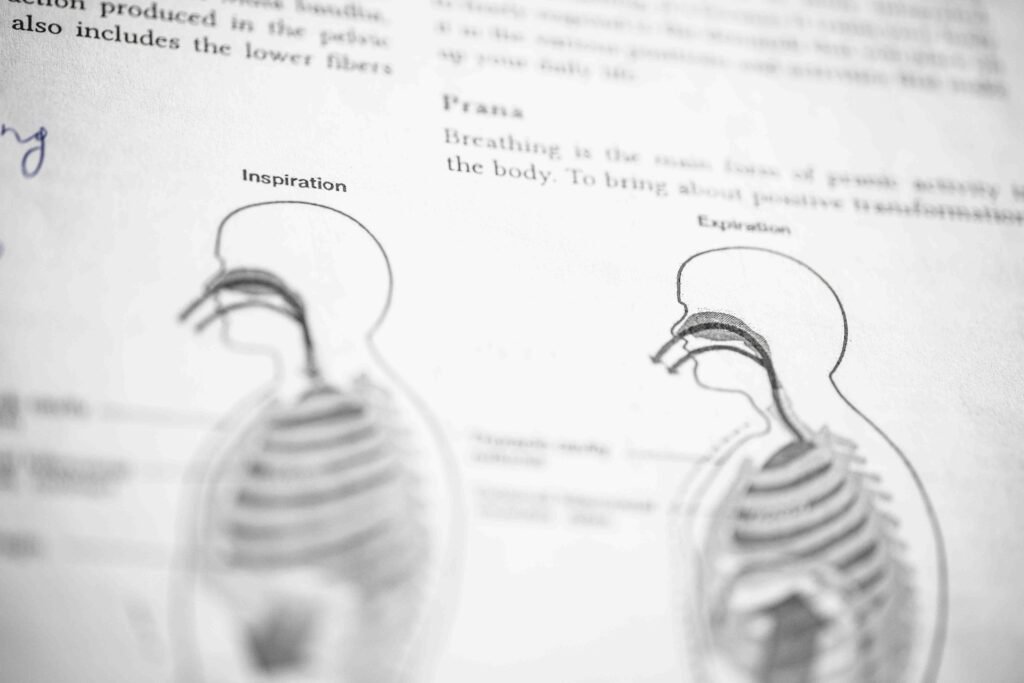
Breathing is one of the few bodily processes that’s both automatic and consciously controllable, giving it real power over the nervous system. Slow, controlled breathing activates the parasympathetic system, lowering heart rate, blood pressure, and stress hormones. Faster, forceful breathing activates the sympathetic system instead, increasing alertness and arousal. This is basic physiology, not unique to yoga, but yoga catalogued techniques exploiting this mechanism long before science could explain why they worked.
The Hatha Yoga Pradipika, a foundational hatha yoga text, describes breath control as the means by which the mind is stilled: calm the breath, and the mind follows. Techniques were generally framed as preparation for meditation, though physical benefits were also recognised.
Anulom Vilom (alternate-nostril breathing)
Anulom vilom involves breathing slowly through one nostril at a time, alternating sides in a steady rhythm. Traditionally associated with balancing the body’s energy channels, in research terms it shows up as calming, with the clearest evidence for lowering blood pressure.
A 2025 randomised trial in people with high blood pressure found a short session measurably reduced blood pressure and heart rate, alongside improved heart rate variability (Mittal et al., 2025).
Bhramari (humming-bee breath)
Bhramari involves a slow inhale followed by a humming exhale made with the mouth closed. A 2024 review of 46 studies, including six randomised controlled trials, found it consistently associated with higher parasympathetic activity, better sleep quality, improved pulmonary function, and lower stress, anxiety, and blood pressure (Chetry et al., 2024). A trial comparing bhramari directly to anulom vilom in hypertensive patients found both techniques improved reaction time and autonomic balance comparably (Chandra et al., 2023).
Traditionally, bhramari is described as producing a state of deep absorption, the humming vibration draws attention inward, functioning as an auditory anchor for meditation, similar in spirit to a mantra.
Kapalabhati (fire breath)
Kapalabhati is rapid, forceful exhalation with passive inhalation, energising rather than calming, designed as preparatory purification before deeper breath and meditation work.
The rapid pattern lowers blood CO2 faster than the body produces it (hypocapnia), causing respiratory alkalosis and constriction of the brain’s blood vessels, a well-documented cause of lightheadedness. This is why it warrants caution for both high and low blood pressure: the forceful exhalation and sympathetic activation can strain the cardiovascular system in hypertension, while the vasoconstriction can tip an already low baseline toward faintness. Outside these conditions, it carries a low risk profile when learned under a qualified teacher.
A 2025 systematic review of four randomised trials found consistent improvements in lung function alongside changes in attention and cognitive performance (Roj et al., 2025).
Bhastrika (bellows breath)
Bhastrika uses forceful, active breathing on both the inhale and the exhale, unlike kapalabhati’s passive inhale and forceful exhale. It sits at the more intense end of pranayama practice and carries the same blood pressure precautions as kapalabhati.
A randomised trial using fMRI found four weeks of bhastrika practice significantly reduced anxiety and negative affect, alongside measurable changes in brain regions involved in emotional processing, including the amygdala and prefrontal cortex (Novaes et al., 2020). Fast breathing here improved mood rather than only sharpening alertness, a reminder that forceful techniques don’t map neatly onto a simple calming-versus-activating split.
Parallels outside yoga
The rapid, forceful breathing in bhastrika closely resembles a technique developed independently of yoga: the Wim Hof Method, developed by Dutch athlete Wim Hof. It involves 30 to 40 deep, forceful inhales, each followed by a relaxed exhale, then a breath hold after the final exhale, a recovery breath, and a briefer hold, repeated for three to four rounds. Structurally it’s closer to bhastrika, both actively engage the inhale, than to kapalabhati. The breath hold at the end of each round mirrors kumbhaka, a general term in classical pranayama for deliberately pausing and holding the breath, after a full inhale or a full exhale, as its own practice rather than just a gap between breaths.
The strongest research on this style of breathing concerns immune function. In 2012, researchers exposed blood from Wim Hof himself, drawn after an 80-minute ice-water immersion combined with his breathing technique, to a bacterial toxin, and found his inflammatory response markedly different from 112 untrained comparison subjects (Kox et al., 2012). That case justified a controlled trial: 30 healthy men were randomised into a 10-day training group and an untrained control group, both injected with the same toxin, and the trained group showed a significantly reduced inflammatory response and far fewer flu-like symptoms (Kox et al., 2014). The trial used a small, young, male sample, tested an injected toxin rather than a real cold or flu virus, and combined breathing with cold exposure and mental training, so it can’t isolate breathing’s contribution alone.
The breath-holding component itself also has a parallel entirely outside yoga: freediving, where practitioners train specifically to extend a single breath-hold. A review of breath-hold diving physiology found trained divers consistently have larger lung volumes than non-divers, with structured training itself, not just selection into the sport, producing measurable increases in lung volume over time (Elia et al., 2021). A matching finding appears on the yogic side: competitive swimmers who practised a month of yogic breathing, including bhastrika and alternate-nostril breathing with breath retention, showed significant gains in forced vital capacity and maximal voluntary ventilation compared to controls (Hakked et al., 2017). Together, these point to breath-hold training, whether developed for freediving or practised as breath retention within pranayama, being a genuine mechanism for increasing lung capacity, not just a trait shared by people who already had larger lungs.
To Conclude
Anulom vilom and bhramari are slow, calming practices with converging evidence for lowering blood pressure and stress, making them the more broadly appropriate starting point, including for people managing hypertension. Kapalabhati and bhastrika sit at the opposite end, fast and activating, with their own evidence base and their own caution around blood pressure in either direction.
Learned properly, with the precautions above, these techniques carry a low risk of harm. At worst, for someone who doesn’t respond strongly, the practice likely does very little. At best, the evidence points to a real cluster of benefits: lower blood pressure and stress from anulom vilom and bhramari, improved lung function from kapalabhati, reduced anxiety and improved mood from bhastrika, increased lung capacity from breath-retention practice, and, via the Wim Hof research, a measurably different immune response under controlled conditions. Which technique is most appropriate depends on the intended outcome and individual health profile, with a teacher able to help match the practice to both.
References
Chandra, S., et al. (2023). Effects of Nadishodhana and Bhramari Pranayama on heart rate variability, auditory reaction time, and blood pressure: A randomized clinical trial in hypertensive patients. Journal of Ayurveda and Integrative Medicine. https://pubmed.ncbi.nlm.nih.gov/37499590/
Chetry, D., Chhetri, A., Rajak, D. K., Rathore, V., & Gupta, A. (2024). Exploring the health benefits of bhramari pranayama (humming bee breathing): A comprehensive literature review. Indian Journal of Physiology and Pharmacology, 68, 71–85. https://ijpp.com/exploring-the-health-benefits-of-bhramari-pranayama-humming-bee-breathing-a-comprehensive-literature-review/
Elia, A., Gennser, M., Harlow, P. S., & Lees, M. J. (2021). Physiology, pathophysiology and (mal)adaptations to chronic apnoeic training: a state-of-the-art review. European Journal of Applied Physiology. https://www.ncbi.nlm.nih.gov/pmc/articles/PMC8144079/
Hakked, C. S., Balakrishnan, R., & Krishnamurthy, M. N. (2017). Yogic breathing practices improve lung functions of competitive young swimmers. Journal of Ayurveda and Integrative Medicine, 8(2), 99–104. https://pmc.ncbi.nlm.nih.gov/articles/PMC5496990/
Kox, M., Stoffels, M., Smeekens, S. P., van Alfen, N., Gomes, M., Eijsvogels, T. M., Hopman, M. T., van der Hoeven, J. G., Netea, M. G., & Pickkers, P. (2012). The influence of concentration/meditation on autonomic nervous system activity and the innate immune response: a case study. Psychosomatic Medicine, 74(5), 489–494. https://pubmed.ncbi.nlm.nih.gov/22685240/
Kox, M., van Eijk, L. T., Zwaag, J., van den Wildenberg, J., Sweep, F. C., van der Hoeven, J. G., & Pickkers, P. (2014). Voluntary activation of the sympathetic nervous system and attenuation of the innate immune response in humans. Proceedings of the National Academy of Sciences, 111(20), 7379–7384. https://pmc.ncbi.nlm.nih.gov/articles/PMC4034215/
Ma, X., Yue, Z-Q., Gong, Z-Q., Zhang, H., Duan, N-Y., Shi, Y-T., Wei, G-X., & Li, Y-F. (2017). The effect of diaphragmatic breathing on attention, negative affect and stress in healthy adults. Frontiers in Psychology, 8, 874. https://pmc.ncbi.nlm.nih.gov/articles/PMC5455070/
Mittal, G., Pathania, M., Bhardwaj, P., Dhar, M., Khapre, M., & Mittal, S. (2025). An exploratory randomised trial to assess the effect of nadi shodhan pranayama as an adjunct versus standard non-pharmacological management in hypertensives. https://pmc.ncbi.nlm.nih.gov/articles/PMC11996816/
Novaes, M. M., Palhano-Fontes, F., Onias, H., Andrade, K. C., Lobão-Soares, B., Arruda-Sanchez, T., Kozasa, E. H., Santaella, D. F., & de Araujo, D. B. (2020). Effects of yoga respiratory practice (Bhastrika pranayama) on anxiety, affect, and brain functional connectivity and activity: A randomized controlled trial. Frontiers in Psychiatry. https://www.frontiersin.org/journals/psychiatry/articles/10.3389/fpsyt.2020.00467/full
Roj, A. R., Sharma, H., Pundir, M., Rai, R., & Patra, S. (2025). Yogic bellows, neural sparks: Unravelling the neurophysiological mechanisms of Kapalbhati, a systematic review. Annals of Neurosciences, 32(2), 1–11. https://pmc.ncbi.nlm.nih.gov/articles/PMC12162548/